This site may be going away; please consider the Donate link above... or LiberaPay:
A huge thank you to all who donated in 2025; 2026 Q1 Web hosting 0 / $400; planning a move to much cheaper hosting this quarter.
Buy print-size file for commercial or other use
| 420x500 | 69K | jpg free download |
| 119x142 | 5K | jpg free download |
| 168x200 | 12K | jpg free download |
| 960x1144 | 436K | jpg free download |
| 1920x2288 | 1M | jpg free download |
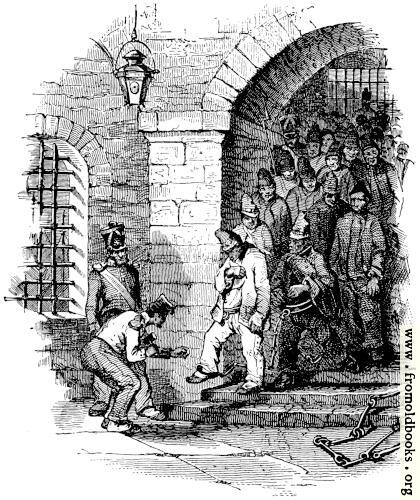
Sounding the irons more
prisons, prisoners, fetters, chains, slaves, slavery, arches, people, men, guards, leg-irons
Some two dozen men are waiting in an archway leading back to prison cells as a guard, in French uniform of the eighteenth or early nineteenth century bends with a hammer to check the manacle and chain on the angle of the first prisoner, which he has raised for the purpose. The chain seems to go back from that prisoner’s leg, or foot, to the waist of the man behind him.
The hammer presumably will make a noise that will sound different if the shackle or leg-iron is broken or has been somehow sawn through.
The illustration, unsigned, appeared in an article, The Forçat as Prison-Breakder talking about escaping from prison.
Now and again, aided by some extraordinary chance, or thanks to an heroic combination of patience, skill, and daring, a prisoner does make his escape even from such a place as Portland [HM Prison Portland in Dorest, UK]; but the attempts are few, and the successes very much fewer; whereas prison-breaking was an art which had hundreds of successful practitioners in the days when the modern system was not thought of.
Famous amongst the feats of their kind are many of the flights accomplished from the bagnes, the convict prisons of France, which superseded in 1748 the old punishment of the galleys.² From many points of view this is the most interesting chapter in the varied history of prison-breaking. There were exceptional opportunities, but there were also very exceptional hindrances. The forçat working in dock or arsenal at Toulon, Brest, or Rochefort, with free labourers all around him, had a better chance than the convict of our day has, who is hardly ever associated with hired workmen.
Where convicts and hired workmen are engaged on the same task, and enclosed within the same walls, the convict has always the chance of effecting a disguise, and passing through the gates unchallenged. A dockyard, too, offers a hundred means of concealment which are wanting in the naked quarries of Portland or on the bogs of Dartmoor.
Again, the garde-chiourme, or warder, of the bagne, tyrant and slave-driver as he was, had a palm much easier to grease than any warder’s in the prison service of those days.
² The system of the galleys had not, however, quite disappeared during the first half of the present century [i.e. 19th C]. The prisoners were occasionally employed at the oar, and the name of forçat, or convict, had not altogether taken the place of the old name of galérien or galley-slave. The bagnes were themselves abolished in 1852, the Government having substituted for them transportation to Guiana.
...
There was another and a worse impediment. It was a terrible part of the punishment of the bagne that every forçat employed at hard labour was chained by the leg to a brother in captivity. This awful companionship was perpetual; the condemned pairs were bound together through every hour of the day, let their task be what it might, and sustained their irons on the wooden bench on which, without changing their clothes, they lay down to sleep at night. This made a serious difficulty in cases where one of the pair was bent upon a flight which his comrade was unwilling to share. In such an event, the adventurer ran the risk of an immediate betrayal. Experience taught the old galérien or forçat that it was safer to dispense with an accomplice, and in working out his scheme alone he needed all his diplomacy to lull the suspicions of his companion of the chain.
Then, the irons were sounded every morning. As the gangs were marched out of the bagne to their work, each forçat, on entering the courtyard from the sleeping hall, presented his fettered ankle to a warder with a mallet, who tapped the steel ring and the links of the chain. Practice had given this functionary so nice an ear that the prisoner who had been stealthily notching his fetters with file or saw during the night must have quaked as he offered them to the test of the mallet in the morning.
p. 573
Social Media