This site may be going away; please consider donating.
A huge thank you to all who donate; 2026 August Web hosting: 100%
Buy print-size file for commercial or other use
| 500x122 | 15K | jpg free download |
| 119x29 | 1K | jpg free download |
| 750x182 | 29K | jpg free download |
| 823x200 | 34K | jpg free download |
| 1187x289 | 72K | jpg free download |
| 2373x577 | 173K | jpg free download |
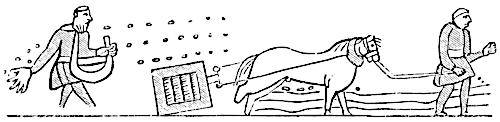
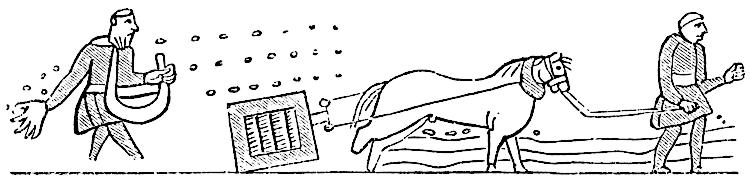
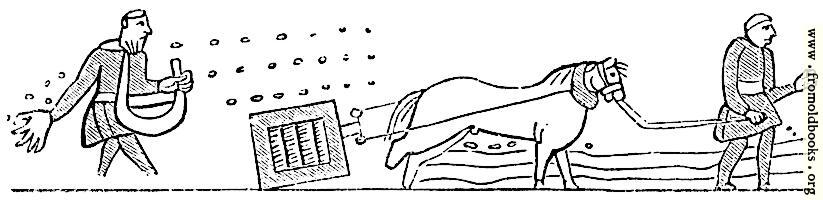
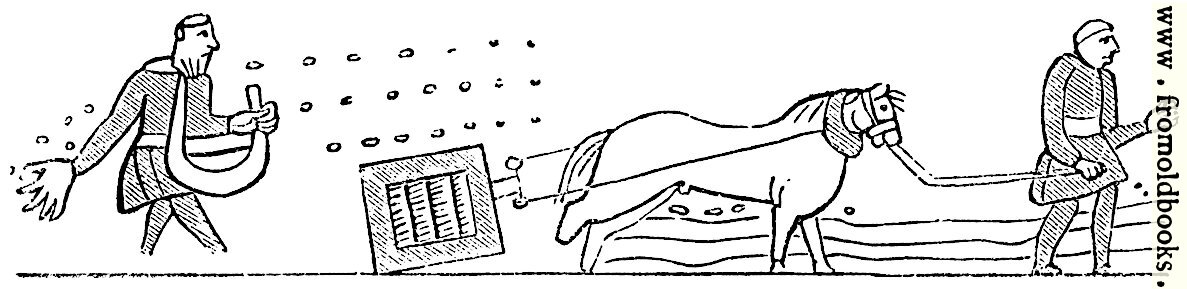
257.—Harrowing and Sowing (Bayeux Tapestry.) more
farming, harrow, ox, horse, sowing, people, men, boys, slaves, slavery
Here we see a man leading what looks to me more likea horse than an ox, which in turn is pulling a harrow made of a rectangular frame with spikes in it; behind follows another man, bearded, sowing seeds.
This is taken from the Bayeux Tapestry, of Norman origin; the book here that reproduces it connects it to Ælfriċ’s colloquy of the enslaved ploughman with his ox, but obviously it’s not a very accurate match.
Fig. 256 is a rude representation, from the Bayeux tapestry, of the wheel-plough. Fig. 257, from the same authority, shows us the sower following the harrow—a more accurate representation than that of the sower following the plough.
We thus see that the opening of the year was the time in which the ground was broken up, and the seed committed to the bounty of heaven. We cannot with any propriety assume that the seed was literally sown in the coldest month, although it is possible that the Winter began earlier than it now does. December was emphatically called Winter-monat, winter-month. The Anglo-Saxon name of January was equally expressive of its fierce and gloomy attributes; its long nights, when men and cattle were sheltering from the snow-storm and the frost, but the hungry wolf was prowling around the homestead.
Verstegan says, “The month which we now call January, they called Wolf-monat, to nit, wolf-month, because people are wont always in that month to be in more danger to be devoured of wolves than in any season else of the year; for that, through the extremity of cold and snow, these ravenous beasts could not find of other beasts sufficient to feed upon.” We must consider, therefore, that the Saxon emblems for January are rather indicative of the opening of the year than of the first month of the year.
There are preserved in the Cotton Library some very curious dialogues composed by Alfric of Canterbury, who lived in the latter part of the tenth century, which were for the instruction of the Anglo-Saxon youth in the Latin language, upon the principle of interlinear translation ; and in these the ploughman says, “I labour much. I go out at day-break, urging the oxen to the field, and I yoke them to the plough. It is not yet so stark winter that I dare keep close at home, for fear of my lord.” (Turner’s ‘Anglo-Saxons.’) We see thus that the ploughing is done after harvest, before the Winter sets in. The ploughman continues, “But the oxen being yoked, and the shear and coulter fastened on, I ought to jilough every day one entire field or more. I have a boy to threaten the oxen with a goad [the long staff represented in the engraving], who is now hoarse through cold and bawling. I ought also to fill the bins of the oxen with hay, and water them, and carry out their soil.” The daily task of the ploughman indicates an advanced state of husbandry. (p.66)
It is worth noting that in the Anglo-Saxon original, the reasaon the ploughman has to work a full acre every day for his master, as well as do other chores, is that he is a slave; this was not a fashionable idea in Victorian England, and was omitted from the translation used here.
Social Media