This site may be going away; please consider the Donate link above... or LiberaPay:

A huge thank you to all who donated in 2025; 2026 Q1 Web hosting 0 / $400; planning a move to much cheaper hosting this quarter.

Old College, Warwick Lane, Londondetails

[Picture: Old College, Warwick Lane, London]
previous image
up

Image title:

Old College, Warwick Lane, London

Taken from

Social Media

Status:

Out of copyright (called public domain in the USA), hence royalty-free stock image for all purposes usage credit requested
Please do not redistribute without permission, since running this site is expensive.

Notes:

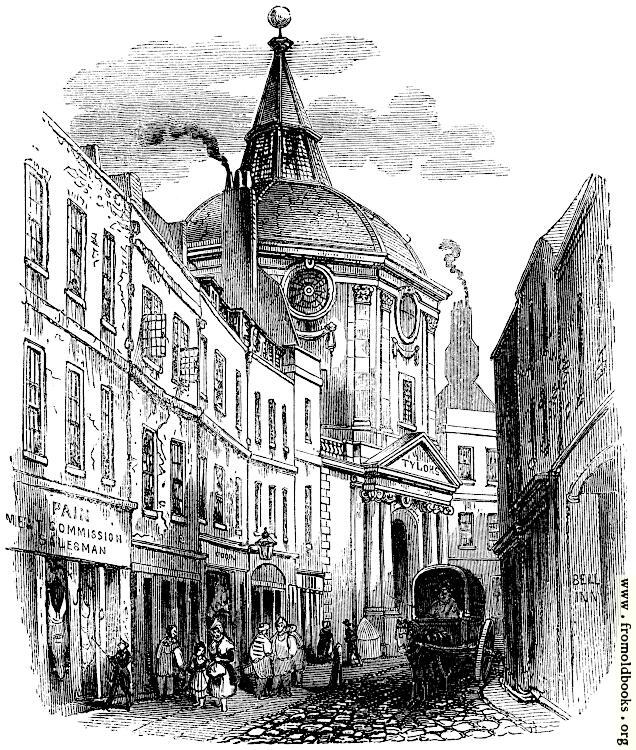
Here we see a cobbled city street, narrow by modern standards, dominated by an octagonal domed building in the background with a tall neoclassical entrance with pillars on either side. In the left foreground a shop sign appears to say “PAIN” and, beneath it, “Meat commission salesman”. On the right is the “Bell Inn” which no longer exists, except possibly in a trace as a small office.

A covered wagon is coming towards us along the cobbles, various pedestrians are walking on the pavement at the side, and a boy with a stick might be about to hit a chicken right in front of PAIN. Above them all, chimneys belch forth the smoke of coal fires.

The college here is the Royal College of Physicians, a building designed by Sir Christopher Wren after the Great Fire of London on 1666 destroyed the older one.

The building was mostly demolished in 1866, twenty-five years after the book was published with this engraving in it.

The removal of the College from Amen Corner was owing to the fire of London, which entirely destroyed the buildings, including those erected by Harvey, the statue of the latter, and the library, with the exception of about 120 folio volumes. For the next few years the members met at the house of the President.

In 1669 a piece of ground was purchased in Warwick Lane, and in 1670 the edifice was begun, from a design by Sir Christopher Wren. It was opened in 1674, under the presidency of Sir George Ent. We need not describe the front of this building; Garth’s verses and the engraving convey a sufficient idea.

The general style of the architecture, we may observe, can scarcely be said to be worthy of the genius that produced St. Paul’s. It was, however, a sumptuously decorated building in the interior, as, fortunately, we may yet see; though our local historians generally pass it without particular notice.

Since the last removal of the society, this their once favourite and splendid hall has been sadly desecrated. The octangular porch of entrance, forty feet in diameter, no longer exhibits on its floor “the dust, brushed off from learned feet;”—no longer now, as of old, does the costermonger of the neighbouring market peep into that mysterious place, and wonder whether its owners, who worked such miracles upon every body else, ever allowed themselves to die;—no longer does the young collector of the Row gaze his soul away in admiration as one of the very men themselves (gods, rather, to his credulous fancy)

“——— his entry made,

Beneath the immense full bottom’s shade,

While the gilt cane with solemn pride

To each sagacious nose applied,

Seemed hut a necessary prop

To bear that weight of wig at top.”

Butchers and meat fill the outer porch, butchers and meat fill the quadrangle within, now so divided off and covered over for their purposes, that it is some time before one can distinguish the outline of the court, or the principal buildings of the College which still surround it. The interior of the octangular pile above the porch formed the lecture-room, which is light and very lofty, being open upwards to the top of the edifice. The general shape and character of this building are preserved throughout; the porch is octangular; there are eight exterior faces to the part above, with eight windows, and the same with the lantern over the dome. The room is now unused.

Crossing the corner of the market or court to the left, we find the way to the more important part of the old College, now used in the business [note: Braziers and Brass Founders] of the gentlemen to whom the entire premises belong.

We are now in the entrance-hall of the building. As we look around and above at the great size and noble proportions of this place, we begin first to have a consciousness of the presence of its illustrious architect. The hall is probably sixty feet high from floor to ceiling, and perhaps about twenty-four feet by twenty square. A truly magnificent staircase runs upwards through it, the balusters most elaborately carved. The ceiling is elegantly decorated in panels. Right up the centre of the place extends a round shaft containing a geometrical staircase within, erected by the present proprietors, as the mode of communication to the rooms at the top of the building. From the staircase we pass into the dining-room, about sixty feet long by twenty-four wide, which has a ceiling that must at once excite the admiration of every visitor. It is divided into three parts; a great circle in the centre and a large oval on each side, the whole formed by very deep and elaborate stucco ornaments of foliage, flowers, &c., on a beautiful light-blue ground. Each of the figures is set in a rich border, filling up all the remaining space of the ceiling. A very broad cornice of similar character extends round the room. The oak carvings also deserve minute attention. They consist of the framework in which the rich marble of the chimney-pieces is set, the bold ornamental wreaths, &c., above, and of a gallery fixed against the wall near the ceiling, which stood formerly in the library beneath, now lost in the alterations of the College. The body of the gallery is supported by brackets carved all over, and of a very handsome massive character; and the upper rail by figures of children (instead of balusters), their lower parts merged into pedestals. The hall is lighted by five arched windows.

Beyond this room is a smaller one as to length, but decorated in the same rich style. So completely is the view of the principal buildings of the college shut out from the court below by the roof with its numerous skylights thrown over the court, that but for the courtesy of the proprietors we should be unable to notice either that or the two statues of Charles II. and Sir John Cutler still existing there [...]. Passing through a window of the counting-house, however, we get on to the roof of which we have spoken, and there, walking about among the skylights projecting upwards breast high, look around us at our leisure.

On the north and south are the buildings which enclose two sides of the quadrangle, formerly used as places of residence by the college officers. On the west is the principal front of the College, consisting of two chief stories, the lower decorated with Ionic pillars, the capitals of which just appear above our feet, the higher by Corinthian, and by a pediment in the centre at the top. Immediately beneath the pediment is the statue of Charles II., with a Latin inscription. Some of the stones in which it is inscribed have been removed for the formation of a window; they are preserved, however, with that care which has evidently characterized all the alterations of the proprietors, who certainly have injured the original building and its decorations as little as possible. On the east is the octangular pile, and its somewhat mean-looking dome; with the gilt ball or “pill’ above, and the statue of Sir John Cutler below.

...

In this building the fellows of the College continued to hold their meetings till 1825, when, as Dr. Macmichael observes in his interesting little volume, ‘The Gold-headed Cane,’—“The change of fashion having overcome the genius loci,” they removed to their present building at the corner of Pall Mall East and Trafalgar Square.

(p. 25)

Keywords:

Dimensions:

85 x 98mm (3.3 x 3.9 inches)

Place shown:

Architect:

Comment:

Filename:

tn/025-old-college-warwick-lane-q75-424x500.jpg

Scanner dpi:

2400 dots per inch

Download:

Similar images: