This site may be going away; please consider the Donate link above... or LiberaPay:

A huge thank you to all who have donated: 2025 October/November Web hosting paid

Constantinople Firemendetails

[Picture: Constantinople Firemen]
previous image
up

Image title:

Constantinople Firemen

Taken from

Social Media

Status:

Out of copyright (called public domain in the USA), hence royalty-free stock image for all purposes usage credit requested
Please do not redistribute without permission, since running this site is expensive.

Notes:

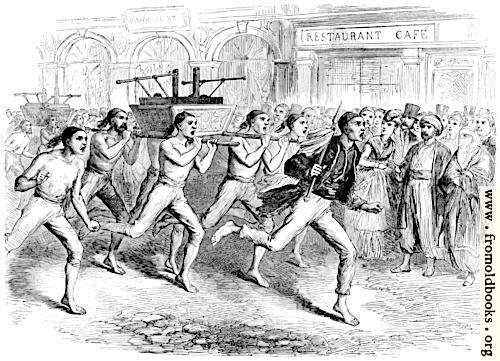
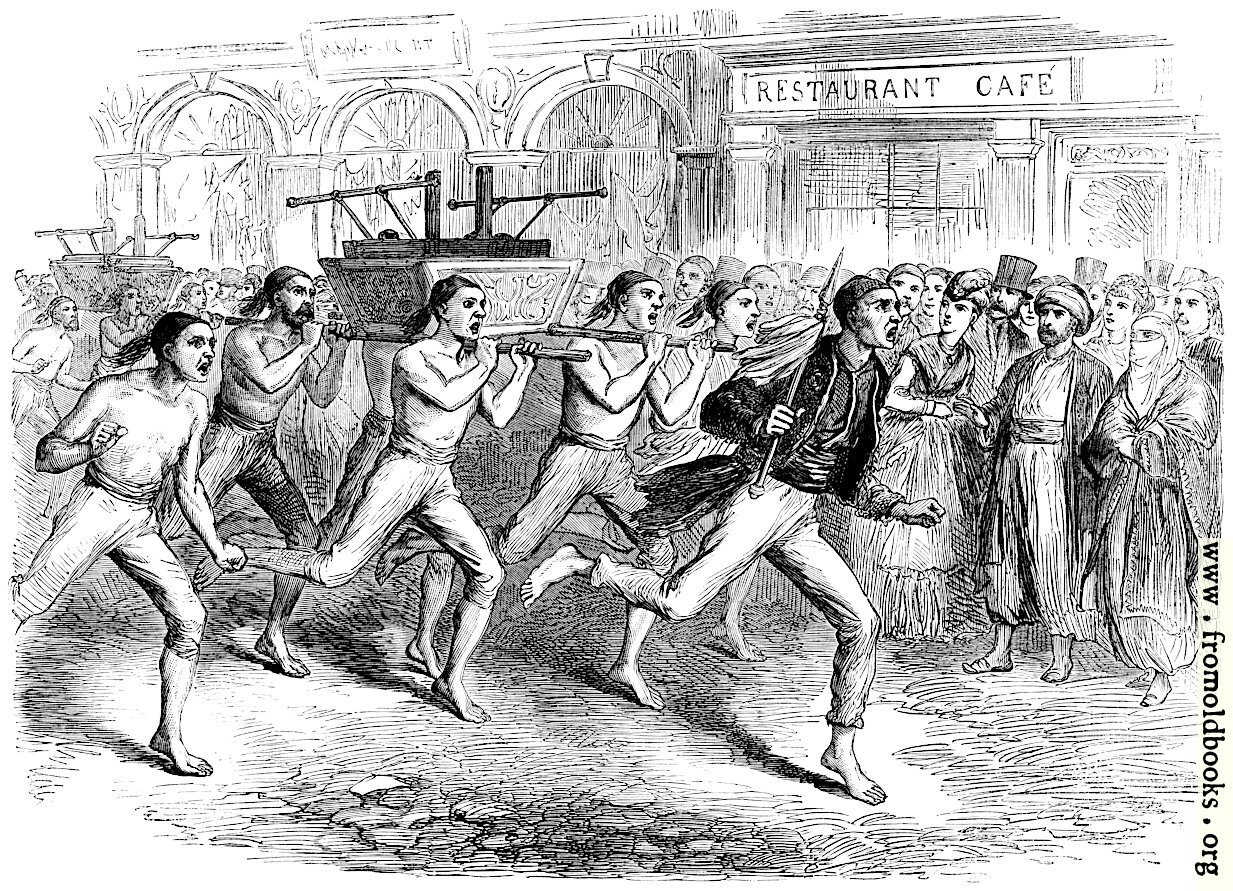
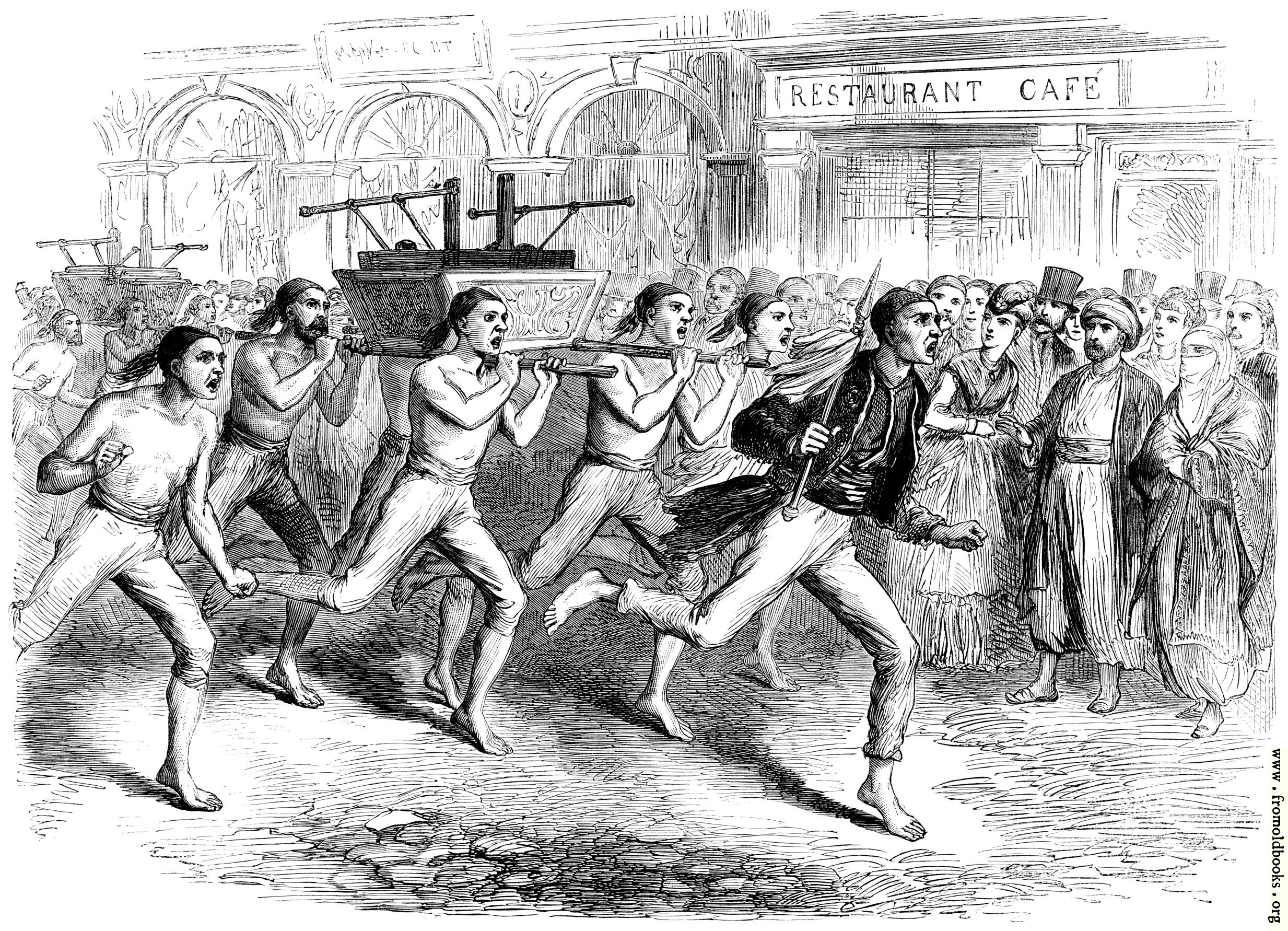
A group of barefoot men rush through busy streets at a run. They are all barefoot, and only their leader has a shirt; he also has a jacket and carries what seems to be a short ceremonial spear, and perhaps is shouting.

The men following at his heels have pumping engines perhaps a metre (a yard) on a side, on pols which they carry on their bare shoulders, for men to a pumping engine. They appear all to be running in perfect step.

The Fire at Constantinople

The great fire which broke out in Constantinople on the 5th inst. [i.e. June 1870], an hour after midnight, and continued burning all the day, caused a terrible loss of life, as well as a vast destruction of property. It commenced in the Validé Tchesmé-street, at the corner of Dzambar-street, and destroyed the whole quarter comprised within the following boundaries :— Validé Tchesmé-street, Dzambar-street, Kavassé Bashi-street, Tatavola Gardens, Kissini Pacha’s Gardens, Hamali Tchesmé-street, the English Embassy, Hamal Bashi-street, High-street, Pera, and Takim-street. This quarter, which was about one square mile in extent, contained nearly 20,000 houses, one-tenth of which were built of stone, the rest being of wood and plaster.

About fifty stone houses in or near the High-street, Pera, were burnt, the spread of the flames being facilitated by the strong north wind. Taksim-street, Hakkiar, Misk, Imam, Sekyz, and Agatch-streets, were chiefly inhabited by rich Armenians, who that day were celebrating the tenth fête of the Constitution, and had therefore formed large pleasure parties and gone into the country. These families have lost everything. Many other inhabitants were also absent in the country, the day being Sunday. Almost the whole of the Italian working class inhabited one of the quarters destroyed, and have suffered greatly. In the superior class of residents the English and Armenian are the greatest sufferers, but it is impossible to state with certainty the amount of their losses. It is estimated that 7000 houses were destroyed, and the loss of property is reckoned at several millions sterling. All precautions were taken at the English Embassy an hour before the fire approached, but it was im possible to prevent the destruction of the mansion. The Ambassador, Sir Henry Elliott, was so absorbed in his efforts to save the building that he took no care of his personal effects, which were all destroyed. Lady Elliott left the Embassy only just in time, as she was nearly suffocated. The archives and documents of the Embassy were saved. Several hundred dead bodies have been found. Large sums of money have already been received from high personages and several capitalists for the relief of the sufferers, and subscription lists are opened in most of the European capitals. Our Illustration, from a sketch furnished by one of our Artists who has frequently visited Constantinople, shows a party of the firemen employed in that city hurrying through the street, and bearing upon their shoulders a small hand-engine to be used for the conflict with the devouring flames. Such an apparatus could do but little against the conflagration we have now to deplore. (p. 638)

Keywords:

Place shown:

Comment:

Filename:

697-Constantinople-Firemen-q85-1233x891.jpg

Scanner dpi:

1800 dots per inch

Download:

Similar images: