This site may be going away; please consider the Donate link above... or LiberaPay:

A huge thank you to all who donate; 2026 Q3 Web hosting $52.02 / $300.
This site may be going away; please consider the Donate link above... or LiberaPay:
A huge thank you to all who donate; 2026 Q3 Web hosting $52.02 / $300.
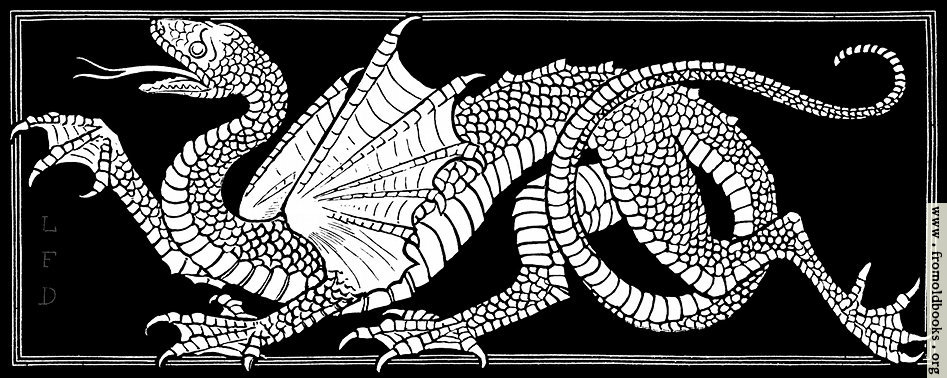
![[Picture: Heraldic Dragon.]](https://www.fromoldbooks.org/Cassell-MagazineOfArt-Vol3/pages/375-heraldic-dragon/375-heraldic-dragon-q85-947x378.jpg "[Picture: Heraldic Dragon.]")


Buy print-size file for commercial or other use
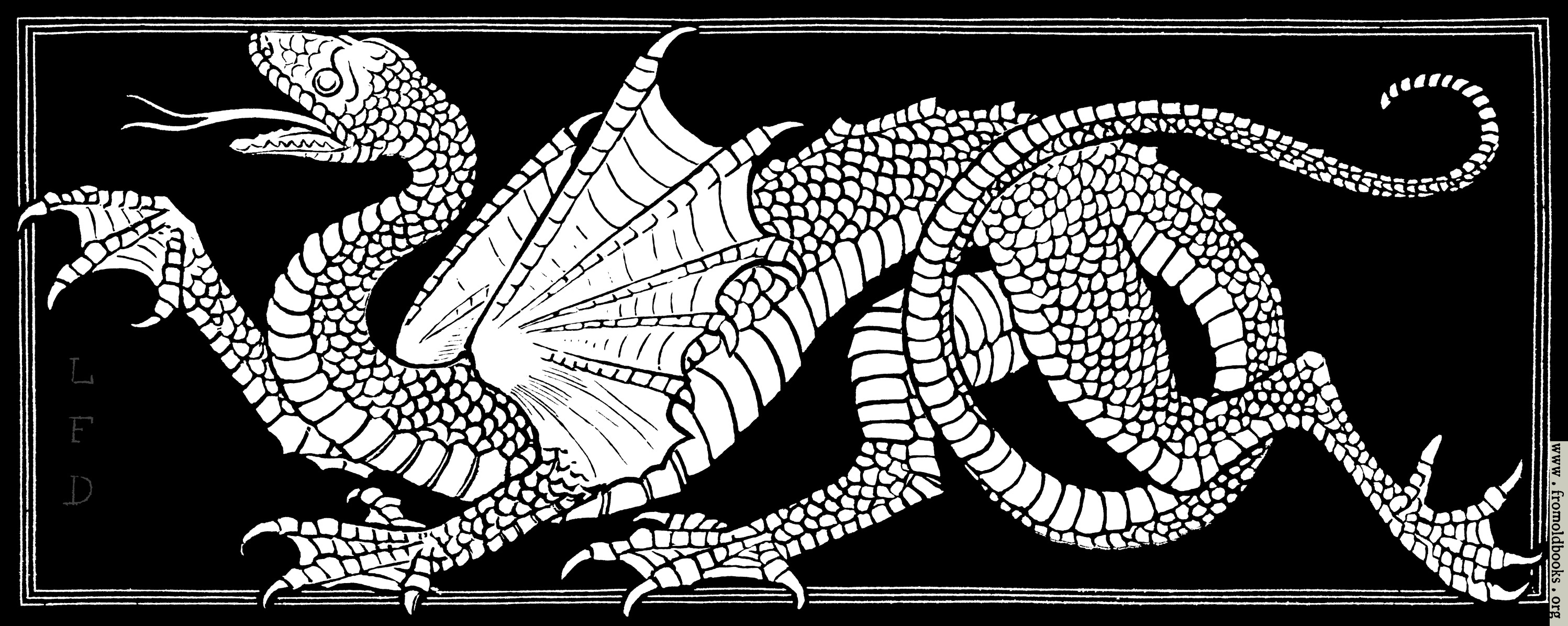
Heraldic Dragon. more
The dragon is, perhaps, the most venerable symbol employed in ornamental art. (p. 375)
Fronm the first the dragon was always a favourite device in heraldry. What more frequent than the dragon-crested helmet of romance? Readers of the “Idylls of the King” will remember “The Dragon of the great Pendragonship,” and the helmet of Arthur,
“To which for crest the golden dragon clung
Of Britain.”
The heraldic dragon conforms, after the manner of its kind, to decorative necessities. His business is to look full of energy and angry power. His jaws are wide; his claws are sharp; wings add to his speed and to his terrors; he is clothed with scaly and impenetrable armour, and he lashes his tail in fury; and all the while he is careful so to spread himself out, on shield or banner, that all his powers may be displayed. In his fiercest rage he is not forgetful of the fact that it is desirable that he should occupy ornamentally the space allotted to him.
In the days before the invention of the term “fine-art,” when no distinction was made between one kind of paintinng or sculpture and another, the dragon was frequently introduced into pictures of sacred and legendary subjects, and it invariably formed an ornamental feature in the composition. The fight with the dragon was a very favourite theme. St. Michael and St. George were habitually represented triumphant over the evil thing; and, in like manner, the virtues trampled trenquilly each on her complementary vice, embodied in the form of some impossible creature. And if the rigid virtues were sometimes insipid, it must be allowed that the demons were usually grotesquely characteristic and often delightful in colour.
[. . .]
If the fabled creature is to live in ornament (and why should it not?) let it be on the supposition that it is a thing of beauty. (p. 378)
This engraving (probably a woodcut) of a dragon appears at the start of an article on dragons in ornament. It is marked L. F. D., presumably for Lewis F. Day, the author of the piece; and, since he died in 1910, more than 70 years ago, the image and text are out of copyright.
Get unwatermarked version
Buy print-size file for commercial or other use