This site may be going away; please consider donating.
December 2026 hosting: 0% paid; a huge thank you to all who donate!

The Magic Ring or Disc of Solomondetails

[Picture: The Magic Ring or Disc of Solomon]
previous image
up

Image title:

The Magic Ring or Disc of Solomon

Taken from

Status:

Out of copyright (called public domain in the USA), hence royalty-free stock image for all purposes usage credit requested
Please do not redistribute without permission, since running this site is expensive.

Notes:

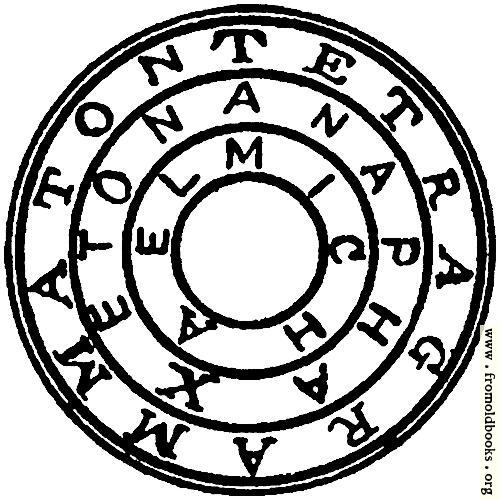
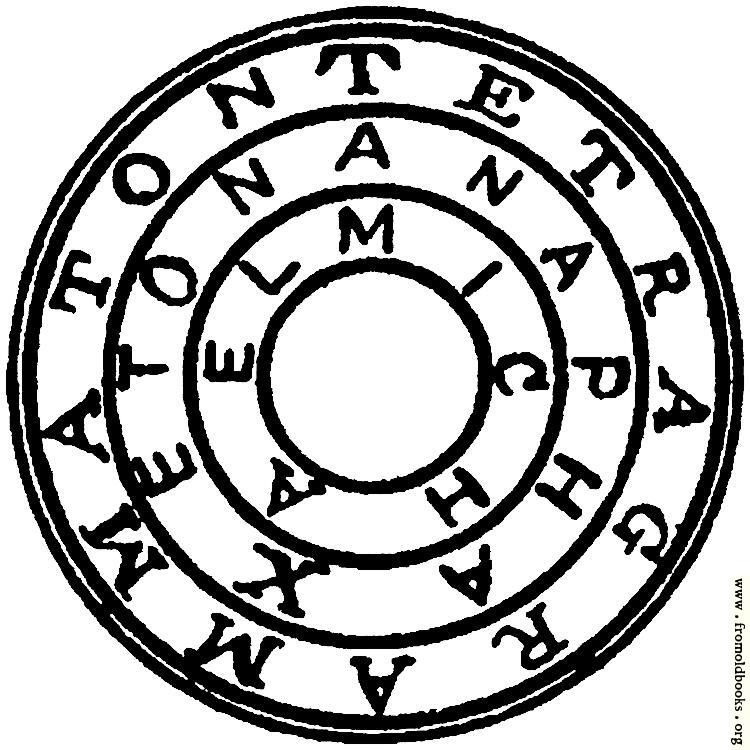
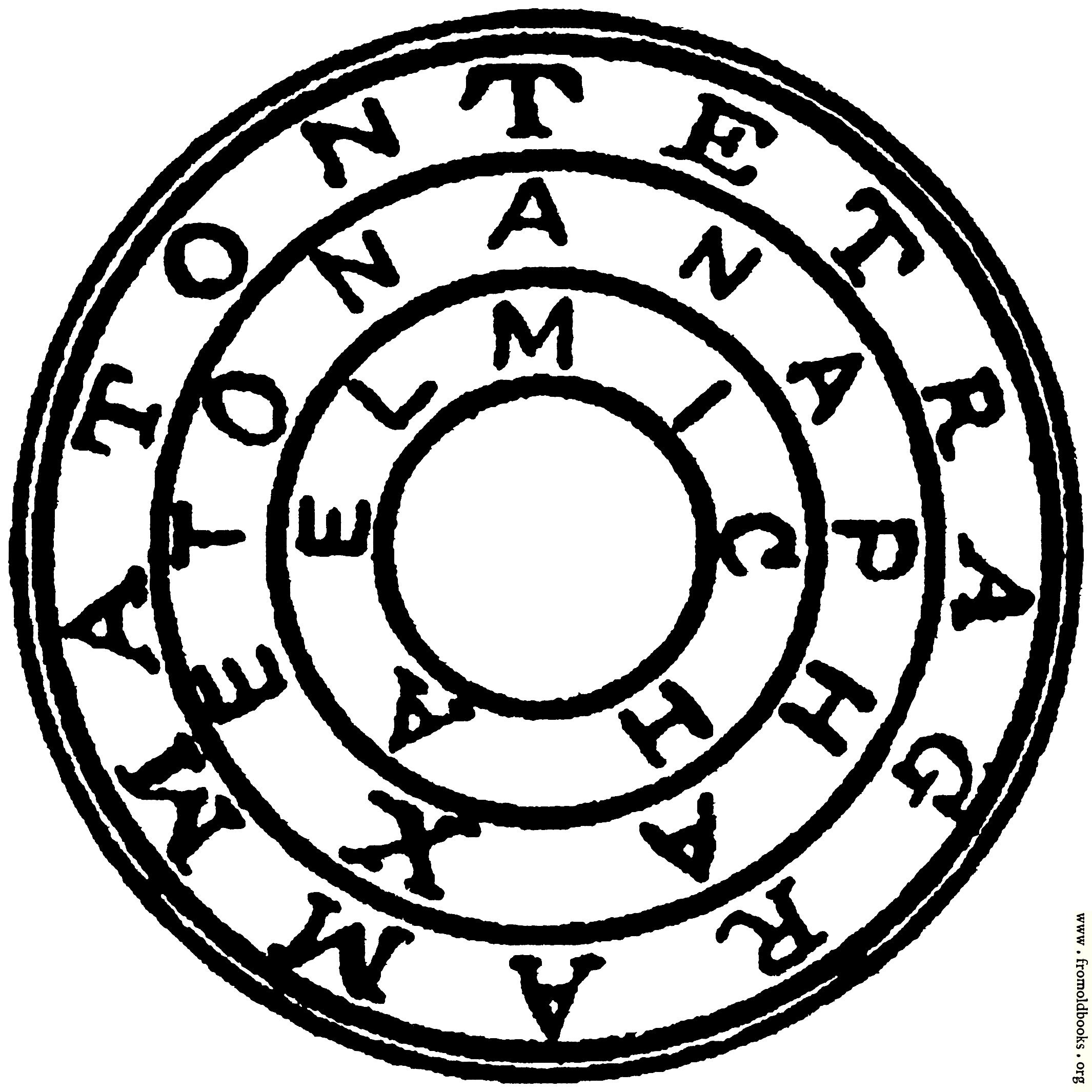
This is the Form of the Magic Ring, or rather Disc, of Solomon, the figure whereof is to be made in gold or silver. It is to be held before the face of the exorcist to preserve him from the stinking sulphurous fumes and flaming breath of the Evil Spirits.

(Colour.-Bright yellow. Letters, black.)

(p. 74)

This design is not, as it stands, anything to do with the King Solomon of Hebrew scripture. For one thing, he would not have used—could not have used—the Latin word Tetragrammaton. The concept, and the four-letter name of the God of ancient Israel, does go back to ancient texts, but not that far.

The Hasidic law, and the switch away from pronouncing the name YHWH out loud and using circomlocutions, came about after the conquest of the region by Alexander the Great near the end of the 4th Century, and archaeological evidence strongly supports this.

In any case Latin as a script was not around until some three hundred years after the time of the supposed King Solomon.

The disc here has three concentric circles wth writing; the innermost circle is blank, and possibly represents a hole.

The outermost circle reads TETRAGRAMMATON.

The middle circle reads ANAPHAXETON, which seems to be a made-up Greek word or possible a now-forgotten proper name.

The innermost circle names the arch-angel MICHAEL.

It is not clear how this would help protect someone from fumes unless it was made large enough to be a shield and the words were not really relevant.

The introduction to the book says the following about it:

The historical Solomon was King David’s son by Bathsheba, and ruled Israel in the tenth century B.C.E. He has long had a reputation as a wise and powerful magician capable of controlling demons. The first century B.C. E. pseudepigraphical Testament of Solomon tells of his building of the Temple of Solomon by magic and the use of demons. The first century E.V. historian Flavius Josephus writes of Solomon that: He was in no way inferior to the Egyptians, who are said to have been beyond all men in understanding; nay, indeed, it is evident that their sagacity was very much inferior to that of the king’s. ... God also enabled him to learn that skill which expels demons, which is a science useful and sanitive to men. He composed such incantations also by which distempers are alleviated. And he left behind him the manner of using exorcisms, by which they drive away demons.

Josephus described witnessing a contemporary, Eleazar, use the ring of Solomon to expel a demon in the presence of the emperor Vespasian and his Roman court. A gnostic Nag Hammadi text describes the creation of 49 androgynous demons whose “names and functions you will find in ’The Book of Solomon”—perhaps the earliest surviving reference to a Solomonic catalogue of demons. The German scholar Kiesewetter suggests that Lemegeton—the name of the compilation of which the Goetia is a part—was the name of a magician belonging to a Gnostic sect, but there is no evidence that a magician of that name ever existed.

(p. xxiii)

However, there is nothing to connect this ring or disc with whatever Josephus described.
Keywords:

Place shown:

Comment:

Filename:

128-magic-Ring-of-Solomon-q85-1065x1065.jpg

Scanner dpi:

1200 dots per inch

Download:

Similar images: